




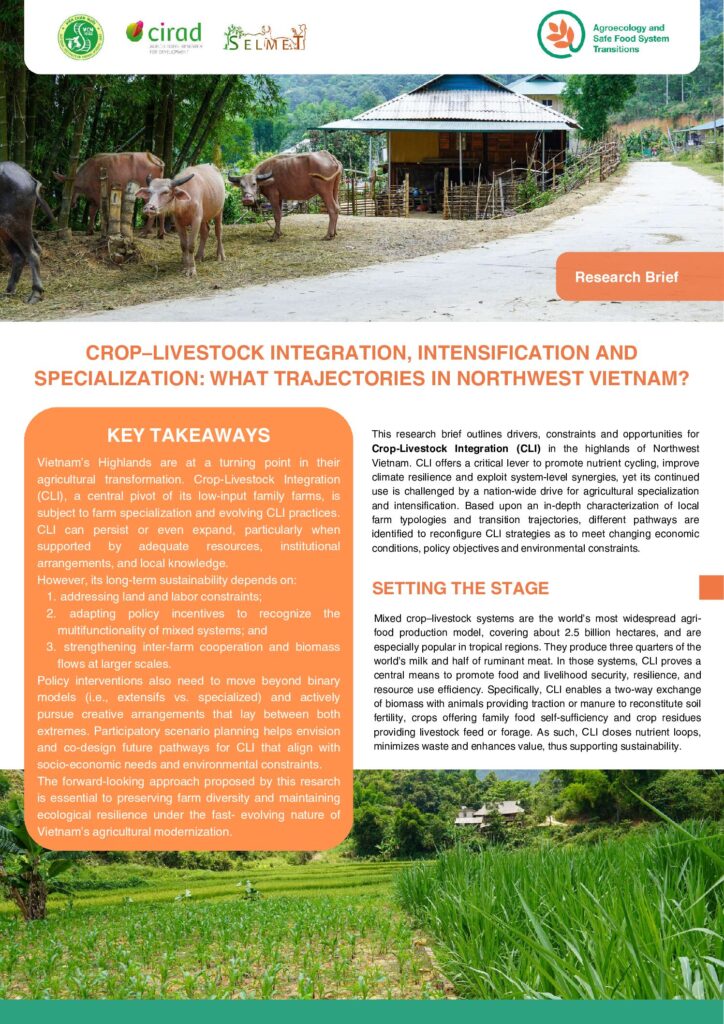
Vietnam’s Highlands are at a turning point in their agricultural transformation. Crop-Livestock Integration (CLI), a central pivot of its low-input family farms, is subject to farm specialization and evolving CLI practices. CLI can persist or even expand, particularly when supported by adequate resources, institutional arrangements, and local knowledge. However, its long-term sustainability depends on: 1. addressing land and labor constraints; 2. adapting policy incentives to recognize the multifunctionality of mixed systems; and 3. strengthening inter-farm cooperation and biomass flows at larger scales. Policy interventions also need to move beyond binary models (i.e., extensifs vs. specialized) and actively pursue creative arrangements that lay between both extremes. Participatory scenario planning helps envision and co-design future pathways for CLI that align with socio-economic needs and environmental constraints. The forward-looking approach proposed by this resarch is essential to preserving farm diversity and maintaining ecological resilience under the fast- evolving nature of Vietnam’s agricultural modernization.
Crop–livestock Integration, Intensification and Specialization: What Trajectories in Northwest Vietnam?
{post_terms_insight-type:plain}
