




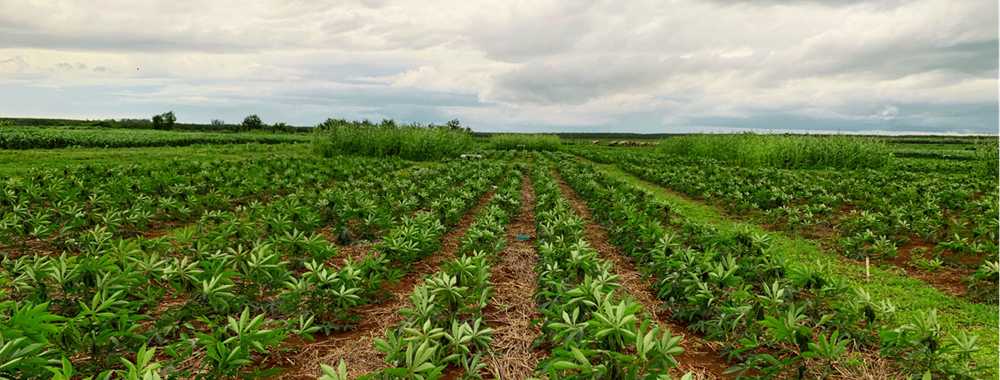
Long-term no-till conservation-agriculture systems in Cambodia’s tropical uplands can rebuild soil organic carbon (SOC) and help offset agriculture’s climate footprint. Using 13-year field experiments in maize-, soybean-, and cassava-based systems, the study tracks SOC and total Nitrogen changes down to 1 m soil depth under conventional tillage monocrops versus no-till monocrops with cover crops and no-till rotations with cover crops.
.
Main message of the chart
The chart shows that diversified no-till systems deliver the largest climate benefits because soil organic carbon gains are substantial. In comparison to conventional agriculture (0.5 tons of carbon dioxide per hectare and year) no-till cropping can store up to 4 tons of carbon dioxide per hectare and year. In addition, CA systems could also contribute to better farming practices for better products, adding values to the agricultural commodities as “Green Climate Products”.
Implications for policy and practice
- Scale up no-till and cover crops plus rotations as a climate-smart package. SOC gains are strongest where no-till is paired with continuous soil cover and crop diversification, which supports both mitigation and erosion control in upland tropics.
- Account for trade-offs in carbon programs. Carbon-credit or results-based finance should reward systems that increase soil organic carbon and avoid boosting non-CO₂ emissions (notably N₂O), and should monitor permanence/quality of stored SOC.
- Target cassava and maize uplands first. These dominant cash-crop systems had clear soil organic carbon recovery under diversified no-till, making them high-leverage entry points for national land-degradation neutrality strategies.
Sources
Evidence on the impacts of long-term cassava-based conservation agriculture systems on soil organic carbon and greenhouse gas emissions in Cambodia, Research brief by Vira Leng realised under ASSET project , based on : Diachronic assessment of soil organic C and N dynamics under long-term no-till cropping systems in the tropical upland of Cambodia
Vira Leng, Rémi Cardinael, Florent Tivet, Vang Seng, Phearum Mark, Pascal Lienhard, Titouan Filloux, Johan Six, Lyda Hok, Stéphane Boulakia, Clever Briedis, João Carlos de Moraes Sá, and Laurent Thuriès SOIL, Volume 10, issue 2, 699–725, the European Geosciences Union
DOI: https://doi.org/10.5194/soil-10-699-2024