Can organic rice certification curb the pressure of the agrarian transition in Cambodia? A farming system approach

Over the past two decades, the Mekong region has experienced significant transformation of its agricultural sector from subsistence farming to export crops driven by the expansion of agricultural land and of irrigation, plus intensification thanks to mechanization and the use of chemical inputs. In the context of agrarian transition, maintaining “organic by default” rice farming systems that do not rely on chemical inputs, is challenging. Based on a case study in Preah Vihear, the organic province of Cambodia, this paper examines whether organic rice certification can maintain “organic by default” practices in a context of unprecedented agricultural intensification.

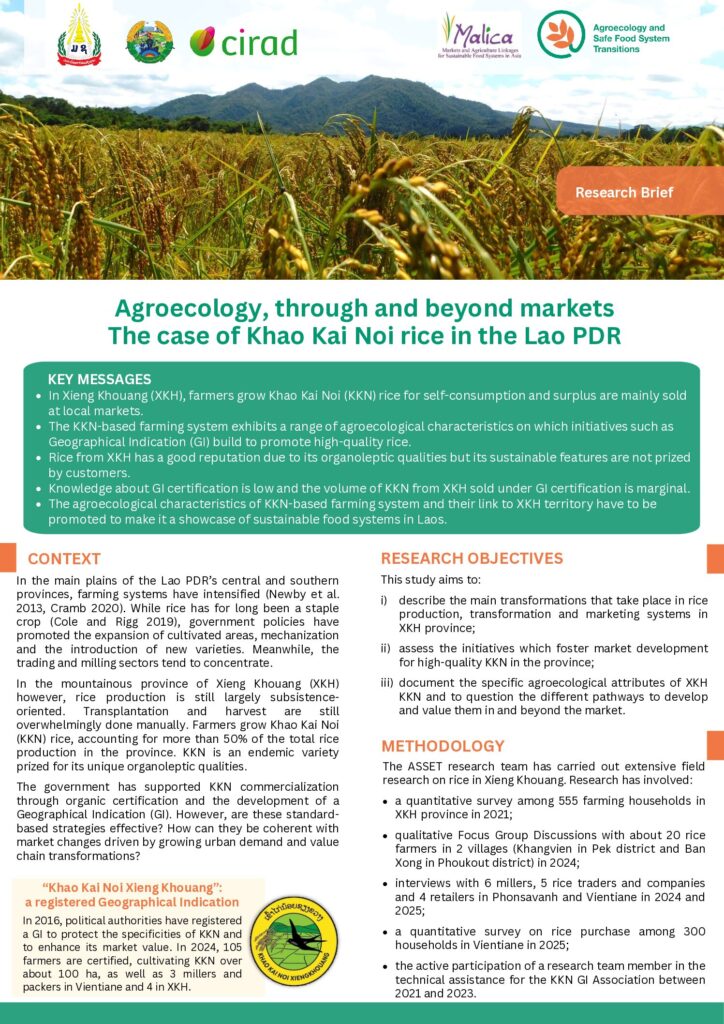
Agroecology, through and beyond markets : The case of Khao Kai Noi rice in the Lao PDR

• In Xieng Khouang (XKH), farmers grow Khao Kai Noi (KKN) rice for self-consumption and surplus are mainly sold at local markets.
• The KKN-based farming system exhibits a range of agroecological characteristics on which initiatives such as Geographical Indication (GI) build to promote high-quality rice.
• Rice from XKH has a good reputation due to its organoleptic qualities but its sustainable features are not prized by customers.
• Knowledge about GI certification is low and the volume of KKN from XKH sold under GI certification is marginal.
• The agroecological characteristics of KKN-based farming system and their link to XKH territory have to be promoted to make it a showcase of sustainable food systems in Laos.

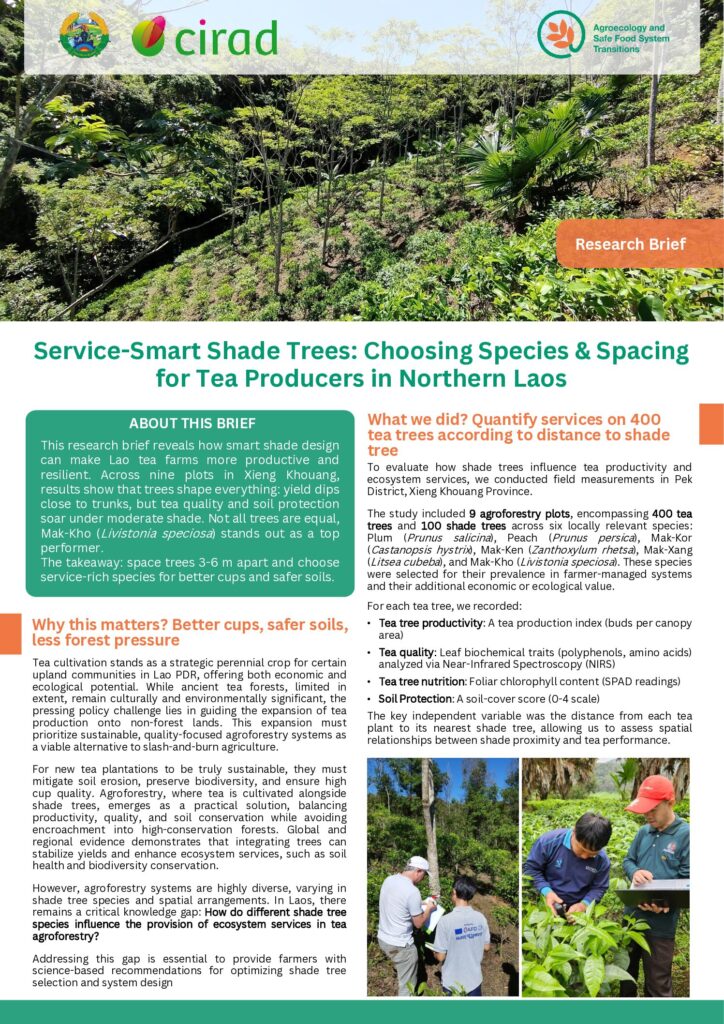
Service-Smart Shade Trees: Choosing Species & Spacing for Tea Producers in Northern Laos

This research brief reveals how smart shade design can make Lao tea farms more productive and resilient. Across nine plots in Xieng Khouang, results show that trees shape everything: yield dips close to trunks, but tea quality and soil protection soar under moderate shade. Not all trees are equal, Mak-Kho (Livistonia speciosa) stands out as a top performer. The takeaway: space trees 3-6 m apart and choose service-rich species for better cups and safer soils.

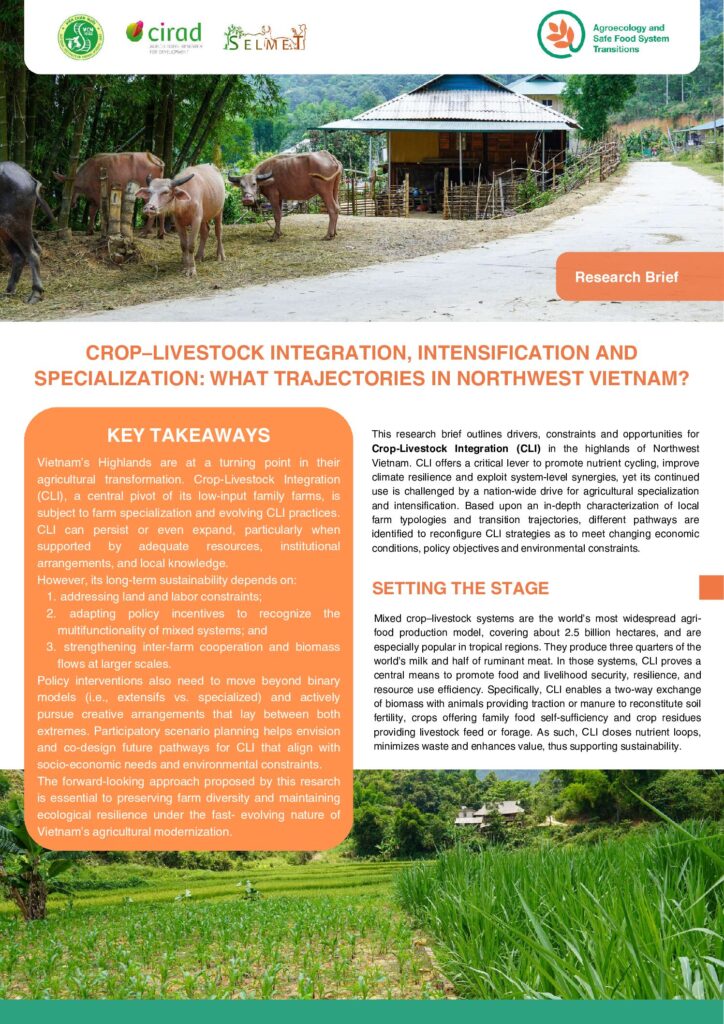
Crop–livestock Integration, Intensification and Specialization: What Trajectories in Northwest Vietnam?

Vietnam’s Highlands are at a turning point in their agricultural transformation. Crop-Livestock Integration (CLI), a central pivot of its low-input family farms, is subject to farm specialization and evolving CLI practices. CLI can persist or even expand, particularly when supported by adequate resources, institutional arrangements, and local knowledge. However, its long-term sustainability depends on: 1. addressing land and labor constraints; 2. adapting policy incentives to recognize the multifunctionality of mixed systems; and 3. strengthening inter-farm cooperation and biomass flows at larger scales. Policy interventions also need to move beyond binary models (i.e., extensifs vs. specialized) and actively pursue creative arrangements that lay between both extremes. Participatory scenario planning helps envision and co-design future pathways for CLI that align with socio-economic needs and environmental constraints. The forward-looking approach proposed by this resarch is essential to preserving farm diversity and maintaining ecological resilience under the fast- evolving nature of Vietnam’s agricultural modernization.

Evidence on the impacts of long-term cassava-based conservation agriculture systems on soil organic carbon and greenhouse gas emissions in Cambodia

The research brief highlights the impacts of Conservation Agriculture (CA) on soil organic carbon (SOC) sequestration and greenhouse gas (GHG) emissions in Cambodia’s upland crops. Findings highlight that soils under CA management act as a soil sink, improving soil health, mitigating climate change and supporting the national food security strategy. The study underscores the need for policy support to scale CA practices.

Input Reduction in Agroecological Practices: A Case Study of Local Practices in Horticultural Production in Northwest Cambodia

Located in northwest Cambodia, Battambang is a well-known province in agricultural productions, especially rice. Pesticide use is prevalent in both upland and lowland rice production in the region, with approximately five to six applications, primarily during the second cycle. Use is reportedly lower in the first cycle. In response to these actions, agroecological practices have been promoted actively in the area by various institutions and projects working at national and local levels.